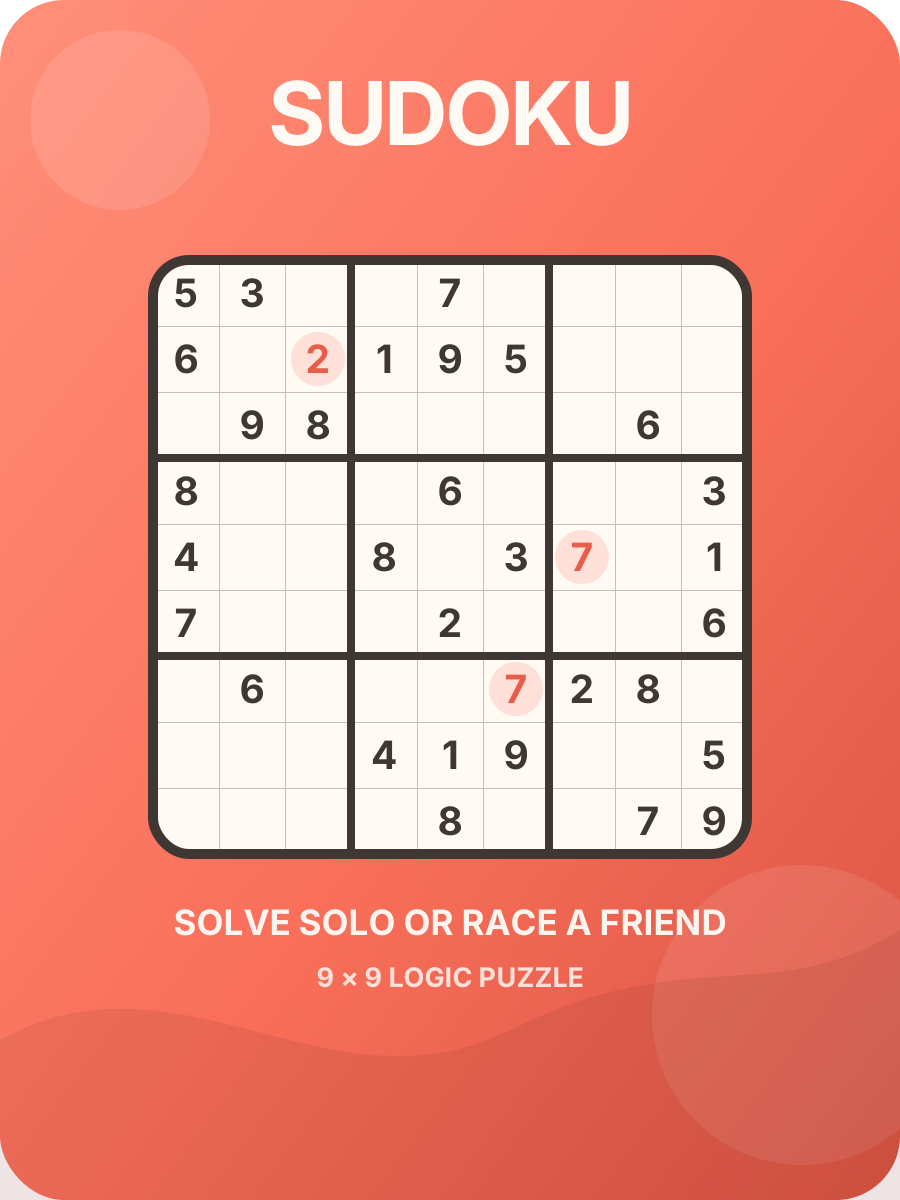
How to play Sudoku: a visual guide
Sudoku is a logic puzzle on a 9×9 grid. You fill the empty cells so that every row, column and 3×3 box holds the digits 1 to 9 once each. There's no arithmetic and no guessing. This guide covers the rules, the solving habits that work, and how solo, race and together games run on PlayFaceToFace.
The grid and the givens
A Sudoku grid has 81 cells in nine rows and nine columns, split into nine 3×3 boxes. A puzzle starts with some cells already filled in. These givens are fixed, so you can't change or erase them. Your job is to fill every empty cell with a digit from 1 to 9.
There is one rule, applied three ways. A digit may appear only once in each row, once in each column and once in each box. So a finished grid holds 1 to 9 exactly once in every row, column and box.
Placing a digit
Pick an empty cell and enter a digit. Before you do, check the three groups the cell belongs to: its row, its column and its box. If the digit already appears in any of them, it can't go there.
Take c1, the third cell of the top row. (Columns run a to i from the left, rows 1 to 9 from the top.) Row 1 already has 5, 3 and 7. Column c has an 8. Box 1 adds 6 and 9. That leaves 1, 2 and 4.
Three candidates aren't enough to place anything yet. Writing them in as small pencil marks helps, and the game's keypad has a notes mode for that.
What the rules rule out
A digit that repeats in its row, column or box breaks the puzzle. A 5 on c1 would repeat the 5 on a1, which shares row 1 and box 1 with it. The game marks clashing digits as soon as you enter them, so a slip shows up right away.
None of these are allowed:
- Repeating a digit in a row, column or box.
- Changing or erasing a given.
- In a race, looking at or editing the other player's grid. Each grid is private and only progress is shared.
Solving: scan, eliminate, place
Most solving comes down to the same loop, repeated until the grid is full.
- Scan the givens. Look for rows, columns and boxes that are nearly full. They have the fewest gaps left.
- Eliminate impossible digits. Use the digits already placed to cross candidates off each empty cell.
- Place a forced value. When only one digit fits a cell, or a digit fits only one cell in a row, column or box, enter it.
- Repeat until the grid is complete. Each new digit is fresh information for the row, column and box around it.
Look at the centre cell, e5. Row 5 rules out 1, 3, 4 and 8. Column e rules out 2, 6, 7 and 9. Only 5 is left, so e5 is 5.
The other kind of forced value starts from a digit instead of a cell. Box 2 needs an 8 somewhere. Column d has an 8 on d5, column e has one on e9 and row 3 has one on c3. That blocks four of the box's five empty cells, so the 8 must go on f1.
Start with the rows, columns and boxes that have the most clues. After each placement, rescan the ones that cross it. One new digit often unlocks the next.
Finishing the puzzle
The puzzle is done when every cell is filled and nothing repeats. In solo play that ends the game. In a race, both players solve the same puzzle on separate grids, and the first to complete a correct grid wins. In a together game you fill one shared grid, so you finish at the same moment and nobody is named the winner.
Race wins go on the room's scoreboard, one point each, so rematches keep a running tally.
Ways to play on PlayFaceToFace
Play a solo puzzle to get used to the keypad, or open a room for two. Before the start, the room picks a mode and a difficulty, and both players see each choice as it's made.
- Challenge gives each player their own grid, and the first correct finish wins. Your opponent sees how many cells you've filled, never your digits.
- Together puts both of you on one grid. Each player's cursor shows where they're working.
Puzzles come in four difficulties: Easy, Medium, Hard and Expert. Medium is the default. For a new puzzle every day, try Daily Sudoku.
Try a quick demo game
A private solo puzzle, right here on the page. Nothing to sign up for.
Sudoku

You know the rules. Pick a puzzle.
Race a friend, solve one grid together, or play solo. No download, no sign-up.